?unique=88858a7)
By 2030, Europe must agree and work on its industrial strategy which needs to consider ambitious climate targets, rising global competition, energy cost volatility and increasing regulatory complexity — all while preserving (retaking) its position as a global industrial leader. The challenge is not incremental improvement but structural transformation to recover the position that is being lost.
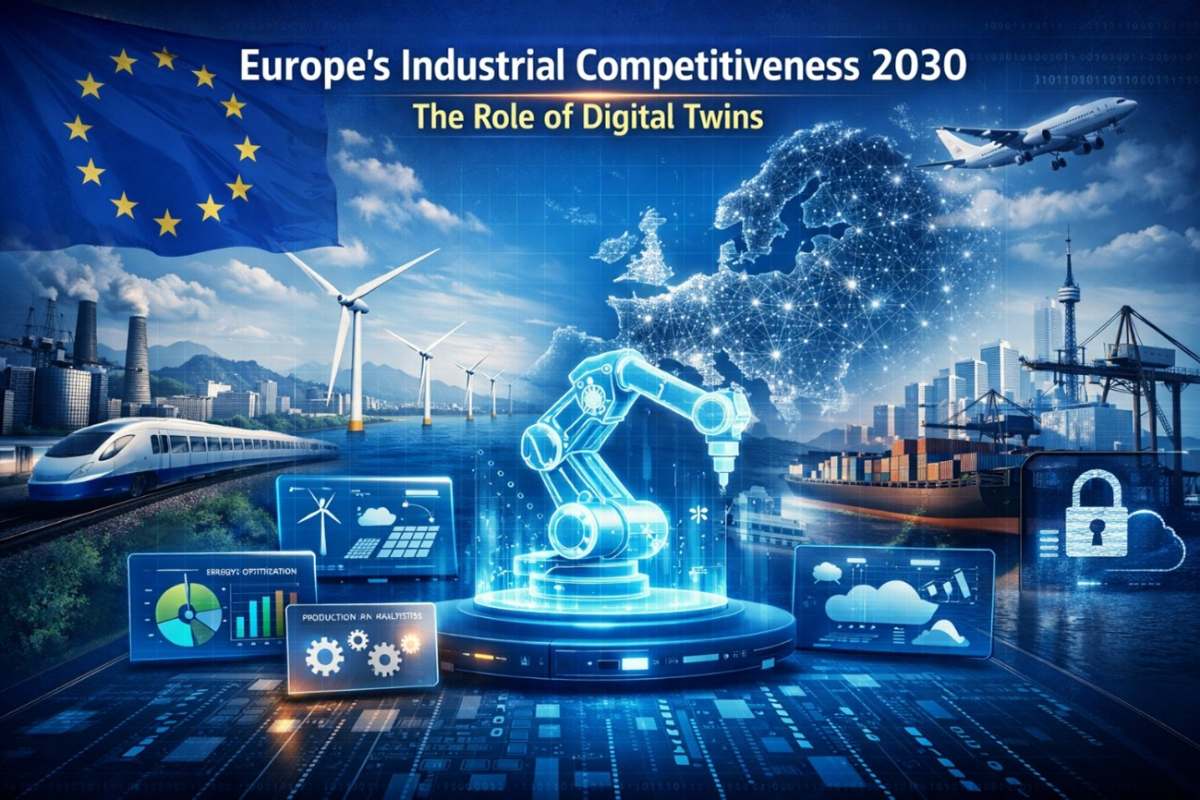
In this context, digital twins are emerging as one of the technologies capable of supporting Europe’s industrial competitiveness. Across sectors such as advanced manufacturing, energy systems, mobility, aerospace and infrastructure, digital twins are moving beyond their origins as engineering simulation tools. They are becoming systemic intelligence layers that connect design, production, operation and lifecycle management into a continuous feedback loop for users. This integration enables faster decision-making, greater operational efficiency and reduced uncertainty — three conditions that will define competitiveness in the coming decade.
One of main weakness of Europe has been the speed at which innovation scales from research to market. While European engineering excellence is widely recognized, time-to-market often lags behind global competitors. Digital twins directly address this issue by enabling simulation-first development. Products and systems can be tested, validated and optimized in virtual environments before physical prototypes are built. Virtual commissioning reduces delays in deployment and design errors are detected earlier, when correction costs are significantly lower. The result is not merely faster launches, but more resilient and adaptable product development cycles.
Competitiveness, however, is not only about speed but about productivity. Europe’s higher structural labor and energy costs require efficiency gains that compensate these disadvantages. Digital twins enable real-time monitoring of industrial assets, predictive maintenance strategies and dynamic process optimization.
At the same time, Europe’s industrial future is inseparable from its sustainability commitments as the Green Deal and related regulatory frameworks are reshaping production standards across the continent. Digital twins allow companies to simulate carbon footprints before manufacturing begins, optimize energy consumption during operations and model lifecycle environmental impacts. Instead of treating environmental compliance as a constraint, digital twins transform sustainability into a measurable and optimizable variable. This capability enables Europe to align environmental ambition with industrial performance.
Strategic autonomy also plays a growing role in Europe’s competitiveness agenda. Technological sovereignty increasingly depends on control over industrial data, digital infrastructure and secure IT/OT integration. Digital twins, when built on interoperable and secure European data ecosystems, contribute to industrial data sovereignty and cross-border collaboration. Integrated with European data spaces and aligned with emerging regulatory frameworks, they strengthen the continent’s capacity to operate independently while remaining globally connected.
A critical factor in this transformation is the inclusion of small and medium-sized enterprises (SMEs). Europe’s industrial backbone is composed largely of SMEs, yet digital maturity varies significantly across regions and sectors. If digital twin adoption remains concentrated in large multinational corporations, Europe risks deepening internal fragmentation. Broad competitiveness by 2030 will depend on scalable, accessible deployment models, supported by Digital Innovation Hubs, funding instruments and coordinated skill development initiatives.
Finally, Europe’s challenge is not a lack of technological capability. It is the risk of fragmentation. Digital twins generate their greatest value when deployed across integrated ecosystems rather than isolated facilities. When supply chains, infrastructure systems, manufacturing networks and energy grids are digitally interconnected, optimization moves from local efficiency to systemic intelligence. This shift from isolated excellence to coordinated digital ecosystems may determine Europe’s industrial trajectory over the next decade.
By 2030, global competitiveness will be dependent on speed, efficiency, sustainability and data sovereignty. Digital twins can be place at the intersection of these dimensions. They accelerate innovation cycles, enhance productivity, support decarbonization and help to strengthen strategic autonomy. Europe does not need to reinvent its industrial strengths. It needs to amplify them through intelligent integration. Digital twins are not a peripheral technology in that effort. They are becoming a structural pillar of Europe’s industrial competitiveness in the decade ahead.
About Digital Twin project
The Digital Twin on Smart Manufacturing project is a European collaborative initiative that brings together education providers, industry partners, and SMEs from several EU countries. Its goal is to develop innovative training programmes and learning resources that support the adoption of Digital Twin technologies in smart manufacturing, helping bridge the gap between education and industry needs and contributing to the advancement of Industry 4.0 in Europe.
References
European Commission. (2020, updated 2023). A New Industrial Strategy for Europe. Brussels: European Commission. Establishes the framework for strengthening Europe’s industrial resilience, strategic autonomy, and digital transformation.
European Commission. (2020). A European Strategy for Data. Brussels: European Commission.
Defines the foundations of European data spaces, data governance models, and digital sovereignty—key enablers for scalable digital twin ecosystems.
European Commission. (2021). Industry 5.0: Towards a Sustainable, Human-Centric and Resilient European Industry. Brussels: European Commission. Introduces the Industry 5.0 paradigm, aligning digital innovation with sustainability, resilience, and human-centric transformation.
Check our website and our Social Media profiles

Funded by the European Union. Views and opinions expressed are however those of the author(s) only and do not necessarily reflect those of the European Union or the European Education and Culture Executive Agency (EACEA). Neither the European Union nor EACEA can be held responsible for them.